A good Halloween crochet project fits the time, yarn and skills you actually have. A flat candy-corn motif asks for increases and colour changes; a bat asks for shaping and careful assembly. A table runner may use simple stitches but takes far more repeated rows. Choose by construction first, then choose the character.
This collection contains 20 articles, including this planning page: original practice recipes, fitting guides and introductions to credited designer patterns. It is not a bundle of 20 physically tested patterns. Each article explains what it provides before you start.
Choose your first make
| Your starting point | A useful first project | What you practise |
|---|---|---|
| You can make a chain and single crochet | Striped square coasters | Counting edges and keeping a square flat |
| You want a small motif | Flat candy corn | Increasing at both ends of a row |
| You want a three-dimensional decoration | A pumpkin from a rectangle | Ribbing, gathering and shaping |
| You already crochet in the round | Mini witch hat | Separating cone increases from brim increases |
| You prefer a designer pattern with photos | Ghost pattern comparison | Selecting a pattern before buying yarn |
All 20 articles in the collection
- Halloween Crochet: 20 Projects and Guides to Plan Your Makes
- Crochet Pumpkin from a Rectangle: Ribbing and Shaping
- Crochet Ghost Applique: A Flat Motif for Halloween
- Crochet Bat Pattern Guide: Wings, Yarn and Assembly
- Crochet Candy Corn Decoration: A Flat Triangle Recipe
- Mini Crochet Witch Hat: Cone, Brim and Shape Checks
- Halloween Crochet Granny Squares: Plan a Matching Set
- Crochet Halloween Garland: Motif Spacing and Assembly
- Halloween Crochet Coasters: A Simple Striped Square
- Crochet Black Cat Applique: Circle, Ears and Face
- Crochet Spider Web Decoration: Pattern and Blocking Guide
- Crochet Halloween Treat Bag: Panels, Handles and Lining
- Crochet Halloween Candy Bowl Cover: Measure a Better Fit
- Halloween Crochet Mug Cozy: Fit It Around the Handle
- Crochet Halloween Wreath: Build a Balanced Display
- Crochet Ghost Patterns: Two Free Designer Options Compared
- Halloween Crochet Pillow Cover: Envelope-Back Sizing
- Halloween Crochet Table Runner: Stripes, Size and Straight Edges
- Halloween Crochet Headband: Fit an Adult Band and Add Motifs
- Halloween Crochet Yarn: Colour Palettes and Scrap Planning
Make one piece before planning a whole set
Start with a single coaster, motif or granny square. Measure it after following the yarn label’s care directions, weigh it if you have a suitable scale, and keep the result beside your notes. That small piece tells you more than a generic promise that a project is quick or uses scraps.
For a garland, measure the finished motif before deciding how many you need. For a pillow, measure the insert before calculating the panels. For anything that wraps a mug or bowl, fit the fabric around the actual object while it is empty and cool. Small differences in tension become noticeable when repeated across a long row or several matching pieces.
Choose a palette that can move between projects
Orange, charcoal and cream make a clear starting palette. Add sage for a softer autumn look or lavender for a brighter Halloween display. Give one colour the largest area and use the others for contrast. If every stripe and motif competes for attention, a simple design can look busier than intended.
Keep the yarn weights reasonably consistent within a joined set. The same hook does not force two different yarns to produce the same square. Our yarn and scrap-planning guide shows how to estimate repeat quantities from a real sample rather than guessing from a photograph.
Build the collection in a useful order
- Choose one small project and write down its actual finished measurements.
- Finish its ends and check how it behaves after washing or blocking, as appropriate for the yarn.
- Make any matching pieces from those notes.
- Assemble a larger project only after the components agree in size.
A ghost applique can become part of a bag, a pillow or a garland. That makes a repeat useful without requiring you to learn a completely new construction every time. Keep decorations for display separate from items intended for everyday use: a raised motif works on a cushion, while a mug needs a flat, stable coaster.
Read the terms and image notes
The original recipes use US stitch names. Check the US/UK crochet terminology guide if you normally follow UK patterns. Linked designers may have their own abbreviations, joining methods and counting conventions, so read their notes before the first round.
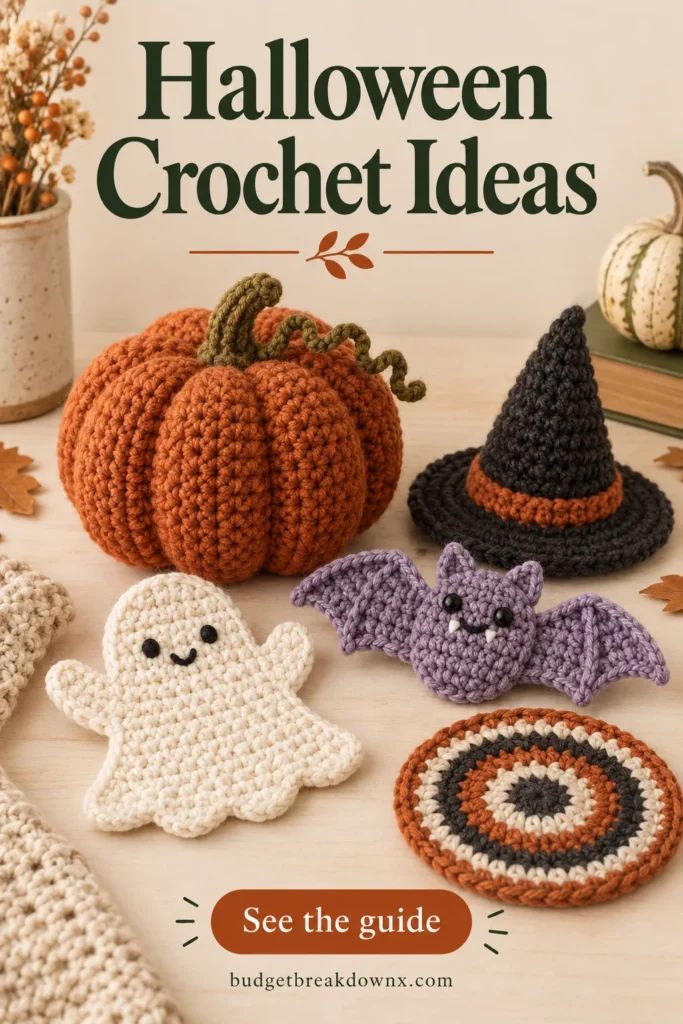
The collection images are AI-generated concepts for colours and styling. They are not stitch charts or proof that a written recipe has been physically tested. Follow the article’s counts, measurements and linked source instructions rather than trying to copy tiny details from an illustration.
Keep making
- Crochet Pumpkin from a Rectangle: Ribbing and Shaping
- Crochet Ghost Applique: A Flat Motif for Halloween
- Halloween Crochet Yarn: Colour Palettes and Scrap Planning
Explore the Halloween crochet collection · Visit the crochet learning library