A striped table runner can use simple stitches, but a long rectangle reveals small counting mistakes. One lost edge stitch in every few rows can create a visible taper by the time the runner reaches the other end of the table.
Choose the width and finished placement first. A short runner that sits within the tabletop and a long runner with overhang need different lengths, even when they use the same stripe pattern.
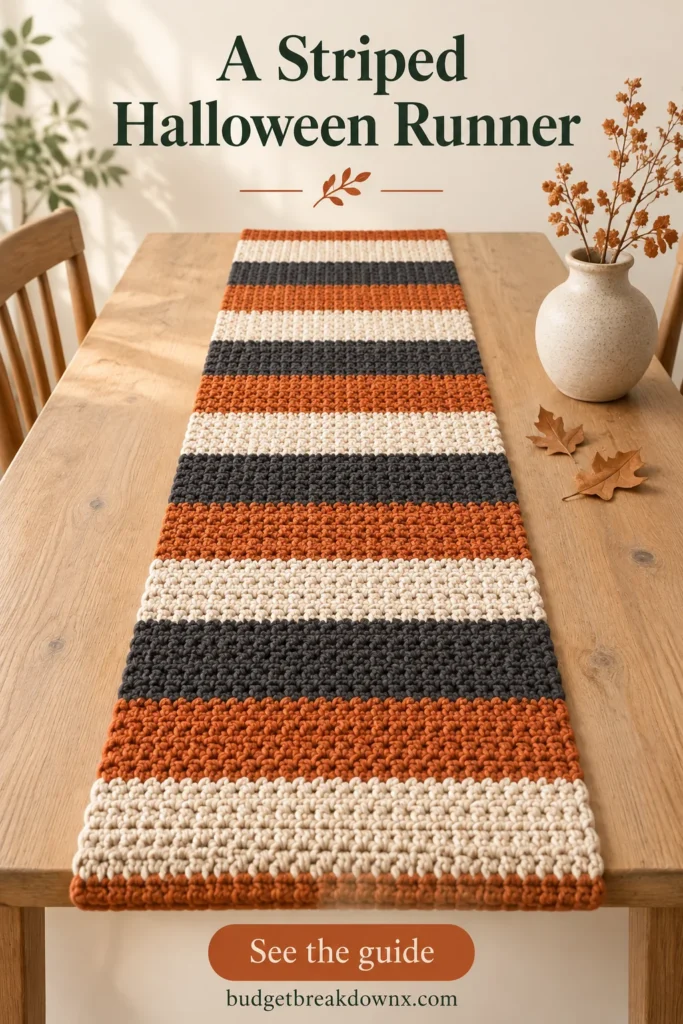
Measure the table and choose the placement
Measure the table’s usable length and width, then mark a possible runner shape with paper or a folded cloth. Leave room for place settings and anything that needs a stable surface. If you want overhang, measure each end separately and include it in the total length.
For a table measuring 120 cm long, a runner that stays 10 cm inside each end would be about 100 cm long. A runner with 15 cm of overhang at both ends would instead be about 150 cm. These are layout examples, not universal decorating rules.
Use a washed swatch for the width
Make a swatch in your chosen yarn and US single crochet, then finish it as the yarn label directs. Measure the central stitches and rows without stretching. Smooth, care-compatible yarns make colour changes and straight edges easier to manage.
At an example gauge of 16 stitches per 10 cm, a 30 cm-wide runner needs approximately 48 stitches: 30 × 1.6 = 48. For the single-crochet construction below, that means chaining 49. Your own swatch may produce a different count.
Pattern note: The stitch arithmetic in this original practice recipe has been checked, but the project has not been physically sample-tested. Make a small trial before using special yarn or producing a matching set. US crochet terms are used.
Work the plain rectangle
- Chain your chosen stitch count plus one.
- Work sc in the second chain from the hook and in each remaining chain. The number of sc should equal your chosen width count.
- For every following row, ch 1, turn and sc in each stitch. The turning chain does not count.
- Keep a marker in the first and last stitch, and compare the width at regular intervals.
Record the completed row count as well as the measured length. A long fabric can stretch while hanging from your hands, so measure it resting on a flat surface. Stop and recount if the side starts slanting; a decorative border should not be used to hide repeated missing stitches.
Plan a stripe repeat
One possible repeat is eight rows cream, four rows charcoal and four rows orange. That is a 16-row cycle with a larger light band. Work a sample cycle to see its actual height before deciding how many repeats the runner needs.
For example, at 2 rows per centimetre, one 16-row cycle measures about 8 cm. A 96 cm striped section would use twelve cycles, before any end treatment. If your target length falls between cycles, decide whether to adjust the end bands or accept a slightly different total length. Do not silently add random rows to each repeat.
Change colours on the last pull-through of the final stitch before a new band. Leave enough tail to weave in securely, and distribute tails within their matching bands so one edge does not become bulky.
Finish the edges with a flatness check
You can leave neat single-crochet edges unbordered. If you add a border, test its spacing along a short section first. Too many stitches along the row ends make waves; too few draw the fabric inward. Corners need enough room to turn without pulling.
Follow the yarn label for washing and shaping. Check the runner on the actual table after it is fully dry. Keep raised motifs away from areas where glasses or dishes will sit, and use appropriate heat protection beneath hot cookware rather than relying on crochet.
Make matching pieces selectively
A pair of flat striped coasters can repeat the same colours without copying the runner’s row counts. Store the runner’s dimensions, stripe sequence and care notes together so a later matching item uses the same palette and compatible materials.
Keep making
- Halloween Crochet Coasters: A Simple Striped Square
- Crochet Halloween Candy Bowl Cover: Measure a Better Fit
- Halloween Crochet Yarn: Colour Palettes and Scrap Planning
Explore the Halloween crochet collection · Visit the crochet learning library