A candy-corn motif is a small lesson in triangular shaping: start at the cream tip, increase at both sides of each row, and finish with the broad yellow edge. There is no stuffing or back panel in this version. It is a flat decoration that can be sewn to a larger project or used in a garland.
The colour order matters more than tiny differences in size. Keep cream at the narrow top, orange in the middle and yellow at the broad bottom, then use the same order for every repeat.
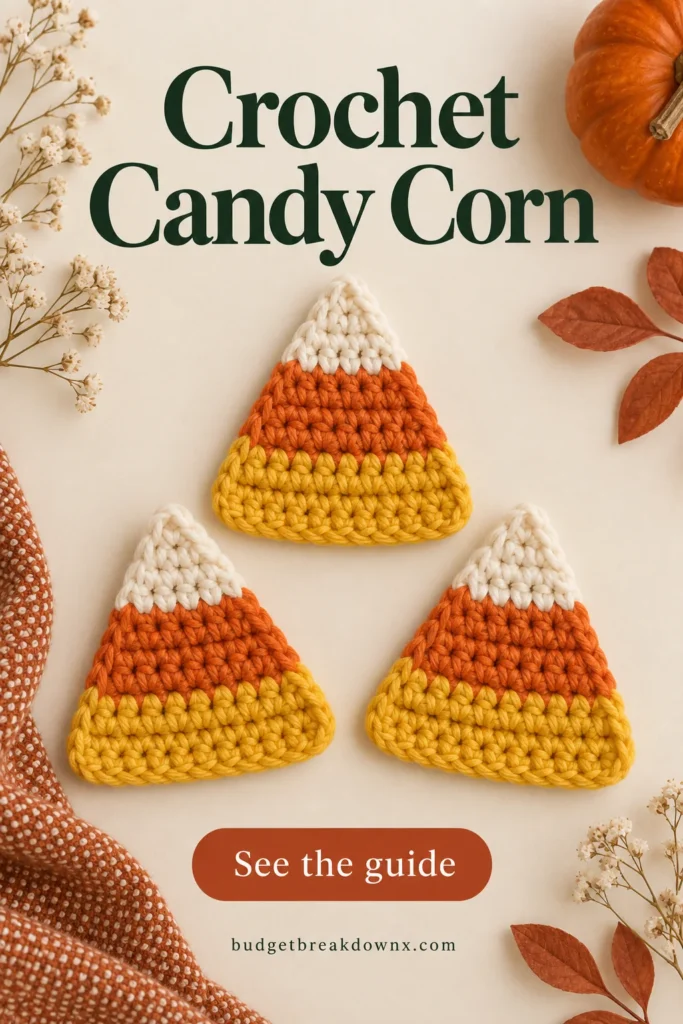
Gather three compatible scraps
Choose cream, orange and yellow yarns with similar thickness and care instructions. You also need a compatible hook, scissors and a blunt needle. A smooth yarn makes the edge increases easy to see. If one scrap is much thicker than the others, the shape can change abruptly at that colour band.
Terms: ch = chain; sc = single crochet; inc = 2 sc in the same stitch. Each increase adds one stitch. You will increase in both the first and last stitch of a row, adding two stitches in total. The turning chain does not count.
Pattern note: The stitch arithmetic in this original practice recipe has been checked, but the project has not been physically sample-tested. Make a small trial before using special yarn or producing a matching set. US crochet terms are used.
Work from the tip to the base
With cream, chain 2. For row 1, work 2 sc in the second chain from the hook. For every later row, ch 1 and turn; work 2 sc in the first stitch, 1 sc in each middle stitch, and 2 sc in the last stitch.
| Row | Colour | Stitches after the row |
|---|---|---|
| 1 | Cream | 2 |
| 2 | Cream | 4 |
| 3 | Cream | 6 |
| 4 | Orange | 8 |
| 5 | Orange | 10 |
| 6 | Orange | 12 |
| 7 | Orange | 14 |
| 8 | Yellow | 16 |
| 9 | Yellow | 18 |
| 10 | Yellow | 20 |
For example, row 5 uses the eight stitches from row 4: an increase in the first stitch, six ordinary sc, and an increase in the last stitch. The result is ten stitches. Counting the middle section helps you catch an accidental extra increase before the triangle becomes lopsided.
Change colour cleanly
On the final stitch of row 3, stop when two loops remain on the hook. Pull the orange yarn through those loops to finish the stitch, then make the turning chain in orange. Repeat at the end of row 7 with yellow. Leave tails long enough to weave securely into the matching colour band.
Because you do not return to an earlier colour, you can cut that yarn after the change. Avoid carrying all three strands up the side: the extra bulk can make one edge stiffer than the other. Before trimming a tail, check that the colour-change stitch has the same tension as its neighbours.
Finish the triangle without distorting it
After row 10, fasten off and weave in the ends on the back. Lay the motif flat. Follow the yarn label if you choose to wash or block it, and shape it gently without stretching one corner farther than the other. This recipe leaves the edges unbordered so the colour bands remain simple.
If the base bows upward, check for a tight final row or tightly woven yellow tail. If one side is noticeably steeper, recount the rows: each row after the first should contain exactly two more stitches than the previous one. Blocking cannot reliably correct a missing increase.
Use the motif in a larger project
For a pouch, sew around the outside with small stitches and keep the pouch’s two layers separate. For a garland, use two attachment points near the upper sides rather than hanging the entire triangle from a single tip. Test the angle before fastening the cord.
Make one complete motif and measure it before planning a row of repeats. Yarn and hook changes affect both height and width, so a fixed row count is not a finished-size guarantee. Save your actual measurements with the colour-change rows to make a matching set easier to reproduce.
Keep making
- Crochet Halloween Garland: Motif Spacing and Assembly
- Halloween Crochet Granny Squares: Plan a Matching Set
- Halloween Crochet Yarn: Colour Palettes and Scrap Planning
Explore the Halloween crochet collection · Visit the crochet learning library