The right yarn for an iPhone 18 crochet sleeve is one that makes a fabric you enjoy using: easy to stitch, comfortable to handle and predictable after washing. A fibre name or a hook size on its own cannot tell you whether the phone will fit. A small comparison swatch gives you much more useful information.
This guide helps you choose the fabric before following our single-crochet sleeve recipe with a free PDF. It applies to the iPhone 18 Pro and Pro Max, as well as other phones measured with their everyday cases. All stitch names are US terms.
Choose a yarn you can read and measure
For a first sleeve, start with a smooth, plied yarn in a colour that makes the stitch tops visible. Try folding a swatch and looking at its edges: can you find corresponding places for a neat seam? Very fluffy or highly textured yarn can make that task harder, especially when you need to undo a temporary seam.
A smooth cotton yarn is one option to sample, and so is a smooth blend you already own. Treat both as candidates. Fibre content, twist, thickness and your tension all influence the fabric. Avoid assuming that every cotton is firm or that every acrylic is stretchy. Judge the actual yarn in the actual stitch.
Make a practical comparison card
Write down the yarn name, fibre content, metres per ball, ball weight, hook size in millimetres and the label’s care instructions. Leave spaces for the dry swatch dimensions and weight. Metres per ball matter when you compare quantities: two 50 g balls do not necessarily contain the same length.
Choose two plausible options rather than buying a large collection. You can use existing leftovers for the comparison if there is enough matching yarn for a project afterwards. Where the yarn is unidentified, label the result as a sample rather than assuming a fibre or wash temperature.
Compare three stitch structures
| Stitch option | What to look for | What changes in the plan |
|---|---|---|
| Single crochet | Visible stitch tops, manageable density and a seam that lies flat | The beginner recipe uses one stitch per repeat |
| Moss stitch | How the chain spaces open when the fabric bends around the phone | Follow its chain-space repeat and count gauge in the correct units |
| Back-loop single crochet | How much the ridged fabric stretches along and across the rows | Keep the swatch orientation the same as the pouch panels |
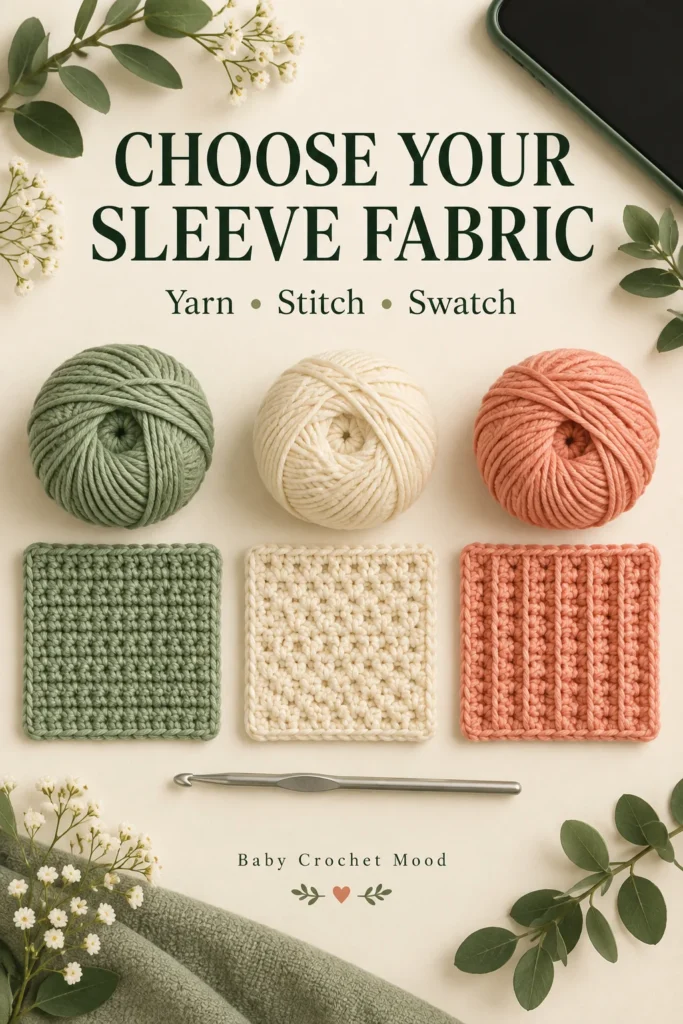
The image is an AI-generated fabric concept, not a stitch chart or a set of measured test samples. Learn the working motions with our single crochet guide and front-loop and back-loop lesson. If you change the stitch from the beginner recipe, recalculate the width and follow the new repeat.
Choose the hook by the resulting fabric
Use the yarn label as a starting point, then make a sample. The Craft Yarn Council recommends relying on millimetre sizes because hook letter and number labels can vary. Keep that millimetre measurement in your project notes.
If the fabric has gaps you dislike, sample a smaller hook. If it is difficult to insert the hook or the fabric feels too stiff to fold, try a larger one. Work a fresh swatch after each change. This is a fabric-design choice, so do not chase another maker’s stitch count at the expense of a fabric you can comfortably make.
Wash first, calculate second
Make each swatch large enough to measure an interior area away from the edges. Photograph or record the dimensions before care, then wash and dry according to the label. Let the fabric settle before measuring again. Use the post-care measurements for your sleeve calculation.
For example, a 20-stitch section that measures 10 cm before care but 9.5 cm afterwards has changed from 2 to about 2.11 stitches per centimetre. A planned 10 cm panel therefore needs about 21.1 stitches, rounded up to 22 for plain single crochet. This is an arithmetic illustration, not a prediction that your yarn will shrink. See our gauge guide for counting help.
Try the seam and the opening
Fold the sample and baste a short seam using the same method you intend to use for the sleeve. Measure how much usable width that seam removes. A thick ridge can matter in a narrow pouch even when the flat swatch looks lovely. If you plan a lining, test a small piece of that fabric between the phone and crochet as well.
Slide the case gently against the dry sample to check whether its texture catches on protruding stitches or loose ends. Do this over a table without scraping the device. Check the opening separately: a decorative top border can change the fit more than you expect.
Estimate yarn from the chosen swatch
Suppose a 12 × 12 cm dry swatch weighs 8 g, and the planned rectangle is 10 × 35 cm. The area-based estimate is 350 ÷ 144 × 8, or about 19.4 g for the main fabric. Add a practical reserve for seams, ends, swatching and any border; 25% would bring that particular planning example to about 24.3 g. Round your purchase up to the available ball quantity.
This approach assumes the same yarn, stitch and gauge throughout. Colour changes and motif joins can alter usage. Keep the final swatch card with your phone measurements, then make the simplest version before adding decorative details. Remove the sleeve for charging and whenever it interferes with normal phone use.