A crochet storage basket works best when the base lies flat and the sides can support themselves. Start with this small 48-stitch practice basket, check the fabric, then decide whether you want a taller version.
What is included: a round base, straight sides, two opposing handle openings and a printable copy. There is no lining or heart appliqué in this pattern. The illustration shows a colour idea, not a finished sample.
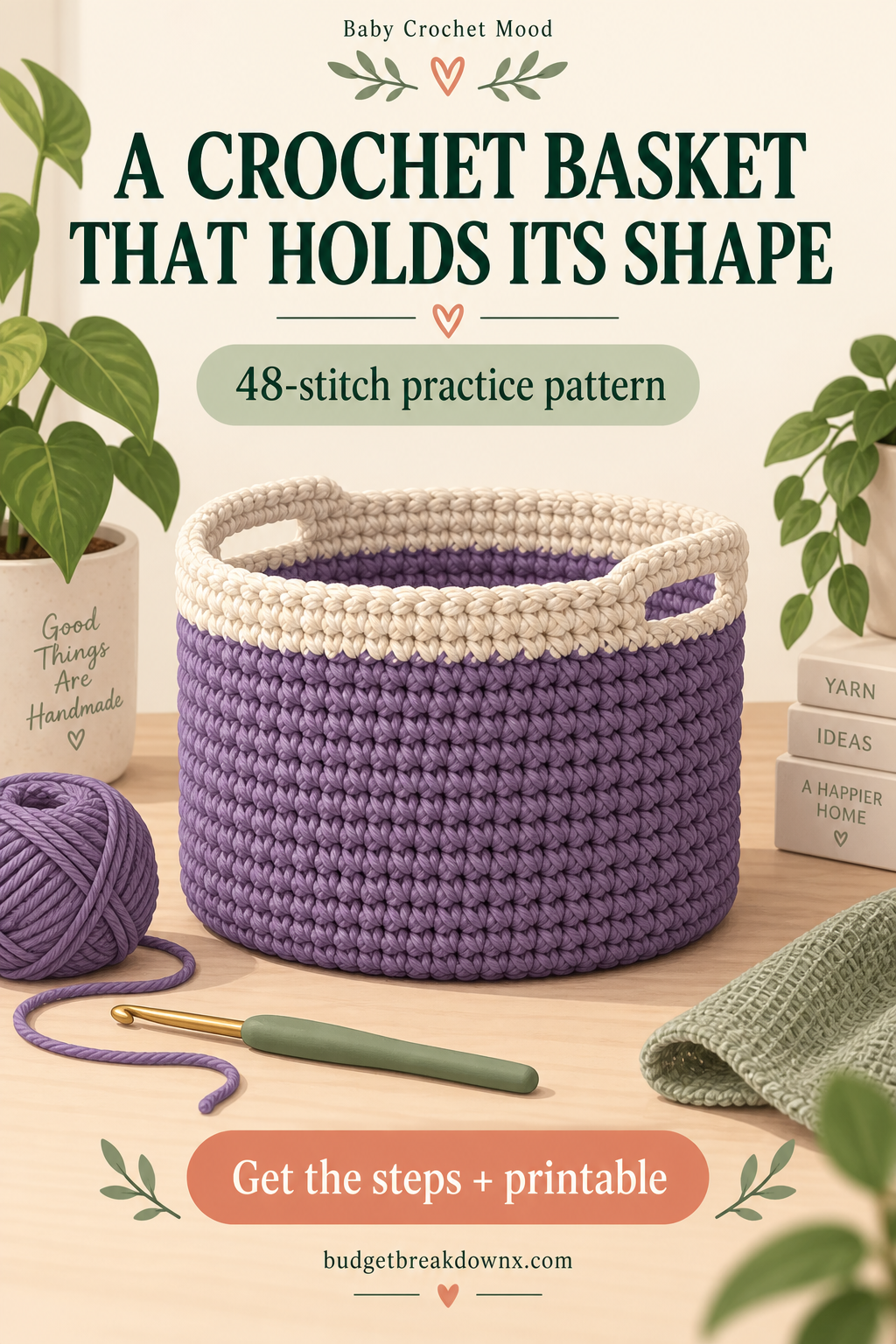
Choose yarn by the fabric it makes
Use a smooth, firm yarn and a hook that produces dense single crochet without making the stitches painful to work. The yarn label is a starting point, not a guaranteed basket recipe. T-shirt yarn can vary in thickness; two balls labelled the same weight can produce different results. You will also need a marker, yarn needle and scissors.
Make a small single-crochet swatch, wash and dry it according to the yarn label, then check whether it holds its shape. A soft swatch may suit a floppy organiser; it will not become a rigid basket just because more rounds are added. Check your own yarn supply as you work; this untested sample has no verified yardage.
Understand the round and stitch rules
These are US terms: ch = chain, sc = single crochet, inc = 2 sc in one stitch, BLO = back loop only, sl st = slip stitch. US single crochet is UK double crochet.
Use joined rounds throughout. At the end of every round, slip stitch into its first sc. Start the next round with ch 1; this chain does not count. Work the first sc into the same first stitch. Never work into the joining slip stitch or the starting chain. Mark the first actual sc so it is easy to find.
Make the flat base: rounds 1 to 8
| Round | Instructions | Stitches |
|---|---|---|
| 1 | 6 sc into a magic ring; close the ring. | 6 |
| 2 | Inc in each stitch. | 12 |
| 3 | (1 sc, inc) six times. | 18 |
| 4 | (2 sc, inc) six times. | 24 |
| 5 | (3 sc, inc) six times. | 30 |
| 6 | (4 sc, inc) six times. | 36 |
| 7 | (5 sc, inc) six times. | 42 |
| 8 | (6 sc, inc) six times. | 48 |
Set the base down without stretching it. It should lie mostly flat. A cupped or rippled base means the increase rate and your fabric are not working together; adjust and sample before continuing. Six increases per round are the starting recipe here, not a universal flat-circle rule for every yarn.
Build the sides: rounds 9 to 17
Round 9: sc in the BLO of every stitch. You still have 48 sc; the unused front loops make a defined turn at the base.
Rounds 10–17: sc in both loops of every stitch, joining each round as before. Keep 48 sc in each round. These are eight ordinary side rounds after the BLO round. For the first sample, finish this count and measure the side height rather than assuming a fixed size in inches.
Add two opposing handles
Change to a rim colour at the start of round 18 if you want the two-tone look.
Round 18: 9 sc, ch 6, skip 6 stitches, 18 sc, ch 6, skip 6 stitches, 9 sc. Join. You used all 48 stitches from the previous round. This creates 36 sc plus 12 chain positions. Each opening begins half a round away from the other.
Round 19: 9 sc, 6 sc into the first chain space, 18 sc, 6 sc into the second chain space, 9 sc. Join. Count 48 sc. Work into the spaces here, not six additional stitches into each individual chain.
Round 20: sc in all 48 stitches. Join, fasten off and weave in the ends. For a basket without handles, replace rounds 18–20 with three ordinary 48-sc rounds.
Measure and troubleshoot your sample
| What you see | What to check |
|---|---|
| The sides fold over | Try fewer side rounds or a firmer swatch. Test the empty basket before adding contents. |
| The rim flares | Count 48 sc. Check for extra stitches in the joins or more than six sc in a handle space. |
| The base is too small | Record its actual diameter. A different yarn/gauge changes both size and fabric; make a new sample before scaling the handle layout. |
| Stitches are hard to work | Try another hook or yarn. Do not force an uncomfortable tension for stiffness. |
Record the yarn, hook, base diameter, height and behaviour after washing. For a later basket with a different stitch total, recalculate the handle spacing; the instructions above are specifically for 48 stitches.
Use and care
Use this as a small organiser for light items. The handles are not a load-rated carrying system. Follow the yarn care label rather than assuming machine washing is suitable. Keep baskets and loose craft materials outside a baby’s sleep space.
Helpful next steps
- Check US and UK stitch names
- Measure a crochet gauge swatch
- Keep track of the first stitch with a marker
- Practise your first 10 single crochet stitches